

In this guide12 sections
Somewhere between “which wavelengths?” and “which brand?” sits a quieter question that shapes daily use more than either: does this mask live on a charger, or on a cord?
It sounds like a small detail. In practice, it decides where you can sit, what happens when you forget to charge, how the mask travels, and — most importantly — whether the routine survives week three. This guide walks through what actually changes between the two formats, so you can choose by routine rather than by marketing language.
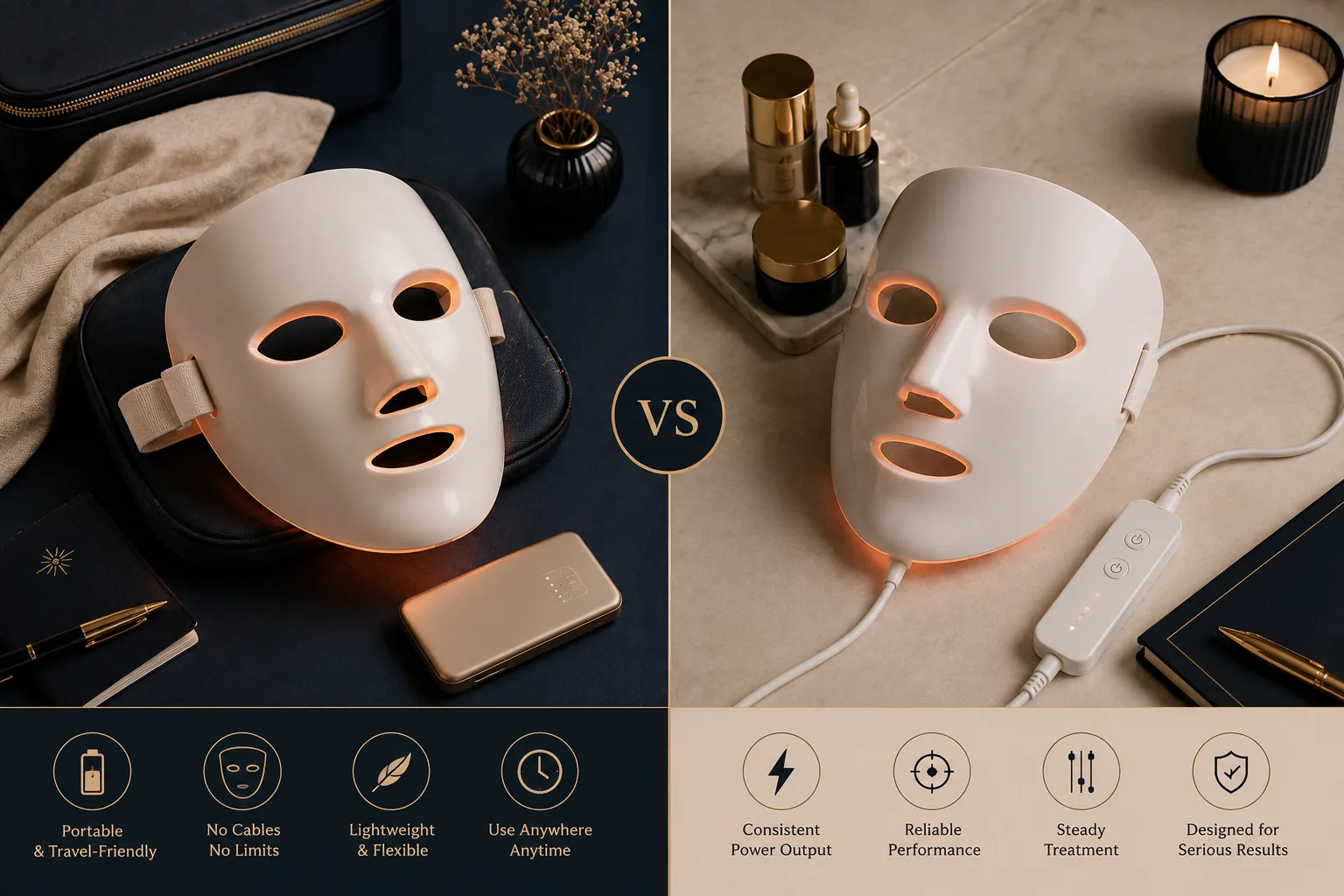
What cordless masks do well
A cordless mask removes the tether. You can start a session in one room and finish it in another, keep it near the sofa instead of an outlet, and avoid the small friction of positioning yourself around a cable every evening.
That freedom has a real effect on consistency for a certain kind of user: the one who resists sitting still. If your realistic routine is “mask on while tidying the kitchen” rather than “mask on in a chair,” cordless removes the excuse that keeps the device in its box.
The trade is a battery — which means charge levels, charging cables anyway (just at different times), battery aging over the years, and a session that can end early if the habit slips.
What corded masks do well
A corded mask never has a dead battery. Every session starts at full, identical power delivery, with no pre-flight check. For a fixed ritual — same chair, same ten minutes, same outlet — the cord is barely a constraint, and the reliability is genuinely calming: the device is simply always ready.
Corded designs also sidestep battery aging entirely. There is no capacity to degrade, no worry about how the mask will behave in year three, and often one less component that can fail.
The trade is placement. Your routine happens within cable-reach of an outlet, and the cable itself becomes part of the fit question: where it exits the mask, whether it pulls, and whether it is long enough for the seat you actually use.
Battery life and charging habits
If you are considering cordless, translate the battery spec into routine language before buying:
- Sessions per charge matters more than minutes per charge. A mask that covers 4–6 sessions needs charging roughly once a week — realistic. A mask that covers 1–2 sessions makes charging part of every use.
- Charge time decides whether a forgotten charge means a skipped evening or a short delay.
- Charging while using is usually not intended — check the manual rather than assuming.
- Battery behavior over time is rarely on the product page. Look for warranty language about the battery specifically, and check whether the battery is replaceable or the mask is effectively disposable when it fades.
None of this is exotic — it is the same thinking you already apply to headphones. The difference is that a skipped charge here quietly breaks a skincare habit you are trying to build.
Comfort, movement, and routine consistency
Format changes how the mask feels in use:
Cordless masks carry their battery somewhere — in the shell, a rear pod, or a controller you clip to clothing. That weight distribution affects pressure points during a ten-minute wear, so a “lightweight” claim deserves the same scrutiny as any fit question.
Corded masks are often lighter on the face for the same build quality, because the power lives at the wall. But the cable adds a small directional pull, and some people find that more annoying than weight.
The consistency question is the honest one: which minor annoyance will you still tolerate in month two? A cable you stopped noticing, or a charging routine you actually keep?
Session reliability and practical use
Reliability is the least glamorous and most decisive difference.
A corded session is deterministic: plug in, start, finish. A cordless session has one more failure mode — insufficient charge — and how the mask handles it matters. Some devices warn early; some dim; some simply stop. The manual, not the product page, tells you which.
Also check what the controls look like in each format. Some cordless masks move controls onto the mask itself or a small remote; some corded masks put them on an inline controller. Whichever format you choose, you should be able to start, stop, and adjust the session without taking the mask off.
Travel and storage
Cordless masks travel more willingly — no adapter chain to plan around at the destination, and a charged mask works anywhere for a few sessions. But check the charger voltage anyway if you travel internationally, and whether the shell is rigid (protective but bulky) or flexible (packable but less protected).
Corded masks tie your travel routine to outlets and, potentially, to voltage compatibility for the power supply itself. For a device that mostly lives at home, that may not matter at all.
Storage is a draw: both formats want a clean, dry spot and a way to keep the surface hygienic — covered in the device-care basics here.
What to check before buying — either format
- The exact battery spec (sessions per charge, charge time) or the exact cable length — in numbers, not adjectives.
- Where the weight sits, and where the cable or battery pod exits.
- What happens mid-session when the battery runs low (cordless) or the power flickers (corded).
- Whether the battery is covered by the warranty, and for how long.
- Whether replacement chargers, cables, or batteries can actually be purchased.
- The full manual, before purchase — including the eye-safety and contraindication sections, which matter more than format. The eye safety questions walk through those in detail.
Who may prefer cordless
- You genuinely will not sit still for ten minutes, and you know it.
- Your routine happens away from convenient outlets.
- You travel often and want the mask to come along.
- Charging devices is already a habit you keep without thinking.
Who may prefer corded
- Your session is a fixed ritual in the same seat.
- You want zero pre-session checks, ever.
- You plan to keep the device for many years and dislike battery aging.
- You would rather tolerate a cable than a charging schedule.
A calm checklist
- I know how many sessions one charge covers, or how long the cable is.
- I know what the mask does when power runs low.
- I know where the weight or the cable will sit on my face and body.
- I know how the battery is treated under warranty.
- I have read the manual, including eye-safety guidance, before buying.
- I chose the format that matches my real routine, not my ideal one.
Related reading
The complete LED mask buying guide compares specific devices and formats in depth. The eye safety questions cover the part of the purchase that matters more than convenience. LED versus microcurrent helps if you are still choosing a technology category, and the Beauty Technology desk keeps the whole research path in one place.
Choose the routine, not the feature
Cordless and corded masks shine the same light. What differs is the shape of the habit around them — charging versus plugging in, moving versus sitting, travel-ready versus always-ready. Picture the specific ten minutes this device will occupy in your week, choose the format that survives that picture honestly, and let the quieter routine win.