

In this guide11 sections
An LED face mask sits closer to your eyes than almost any other beauty device you will ever consider. That single fact deserves more attention than wavelength counts, celebrity mentions, or how sculptural a mask looks on a shelf.
This is not a reason to be afraid of the category. It is a reason to read listings differently. A brand that treats eye comfort and eye protection as first-class information is telling you something about how carefully the whole product was made. A brand that avoids the subject is telling you something too.
Below are seven questions worth answering before any LED mask purchase. None of them require technical expertise. All of them can be answered from the product page, the manual, and the brand’s own support material — and if they cannot, that is itself an answer.
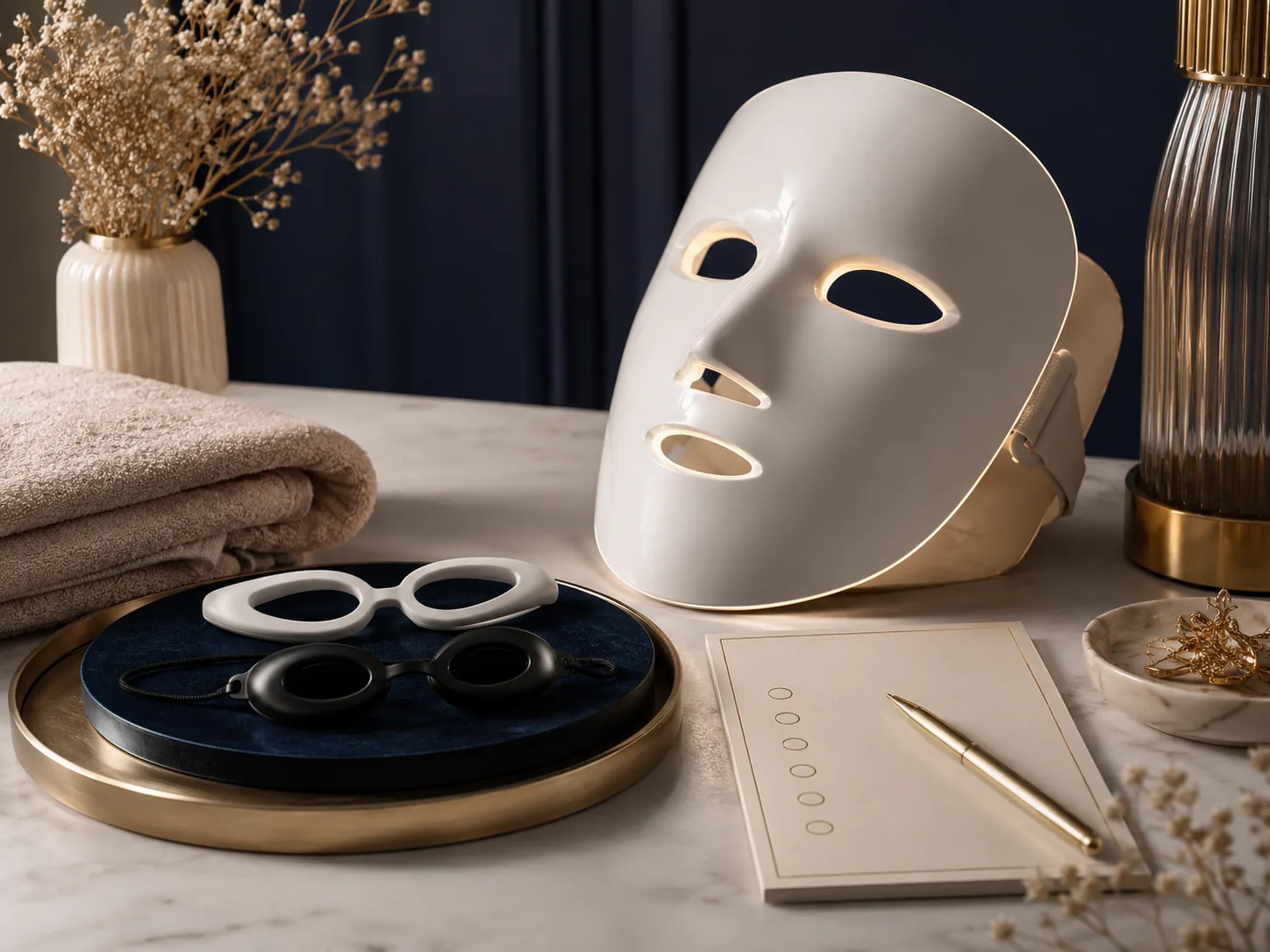
1. Does the brand explain eye protection clearly?
Start on the product page and look for plain statements: whether the mask is designed to be used with eyes closed, whether eye protection is included, and where the full instructions can be read before purchase.
Clear brands tend to explain this without being asked. Vague listings lean on mood photography and adjectives while leaving safety details to a PDF you can only find after buying. Prefer the first kind. You are not being demanding by expecting this — a device worn over your face should come with legible guidance.
2. Does the mask include goggles or built-in eye shields?
Designs vary. Some masks include separate goggles, some have built-in shields or opaque eye zones, and some leave the eye area open and rely on distance, diffusion, and closed eyes.
No single design is automatically “the safe one.” The question is whether the brand states what its approach is and gives instructions that match it. If eye protection is included, check whether replacements are available. If nothing is said about the eye area at all, treat that silence as a meaningful gap.
3. How much light leaks around the eyes?
Even with shields, some brightness around the eye area is normal for many masks. What matters is whether the experience is described honestly: user guidance about brightness, dimmer or intensity settings, and how the mask should sit so light is not concentrated where it should not be.
Reading practical user feedback can help here — not for medical conclusions, but for comfort themes. If many people describe the same mask as uncomfortably bright even when used as directed, believe them, and weigh that against your own sensitivity to light.
4. Are treatment times and distances clearly explained?
A trustworthy listing states session length, recommended frequency, and any rule about how the device should sit against the face. These details exist because dose is part of how LED devices are designed to be used — more minutes are not a bonus feature.
Be cautious with any product whose answer to “how long?” is effectively “as much as you like.” A defined session with an automatic shutoff is both a comfort feature and a sign the brand expects the device to be used within limits.
5. Does the manual say who should avoid use or ask a professional first?
Every serious LED device manual includes contraindications. Common examples include light sensitivity, medications that can increase sensitivity to light, existing eye conditions, recent cosmetic or medical procedures, pregnancy, and certain medical circumstances.
An editorial article cannot tell you whether any of these apply to you, and neither can a product page. If anything on that list is uncertain in your situation — or if you simply are not sure — the calm move is to read the exact manual for the exact model and ask a qualified professional before buying. A missing or trivial contraindication section is a reason to pick a different device, not a reason to feel reassured.
6. Is the fit stable and comfortable enough to keep the mask in place?
Eye safety and fit are connected. A mask that slides, presses on the nose, or needs constant adjusting is a mask whose eye zones are not sitting where the designer intended — and ten minutes of fidgeting is not a routine anyone repeats.
Check the strap design, the weight, the openings, and whether the brand describes how the mask should be positioned. Rigid and flexible masks distribute pressure differently, and a design that suits one face shape can be genuinely wrong for another. Return terms matter here, because fit can only be fully judged at home.
7. Are the warranty, instructions, and support easy to find?
Before buying, you should be able to locate the current manual, the warranty length, the return policy, and a real way to contact support. For a device worn over the eyes, this is not administrative trivia. It is how you resolve a flickering LED, a broken strap, or a question about your specific circumstances after the box is open.
Authorized sellers matter for the same reason: warranty service usually depends on where the device was bought.
What to avoid
A short list of patterns that should end the evaluation early:
- No manual available before purchase. If the instructions are a mystery, so is the product.
- No mention of the eye area anywhere. Silence on the most sensitive part of the design is not minimalism.
- Dramatic claims with no restraint. Language promising transformation, medical outcomes, or “clinically proven” results without any accessible detail deserves skepticism.
- Unclear seller, unclear warranty. A premium price without premium accountability is not a premium product.
A calm pre-purchase checklist
- I can read the full instructions before buying.
- I know how this mask handles the eye area, and the approach is explained.
- I know the session length, frequency, and any distance or positioning rules.
- I have read the contraindications and none of them are unresolved for me.
- The fit, weight, and brightness sound manageable for my face and sensitivity.
- I know the warranty terms, the return rules, and who the authorized sellers are.
- I am buying this as a cosmetic routine tool, not as a substitute for professional care.
If every box is honestly checked, you are making a considered decision. If several are not, waiting costs nothing.
Where this fits in your research
This article is the safety-reading companion to the complete LED face mask buying guide, which compares formats, session design, and specific devices in more depth. If you are still deciding between technology categories, LED versus microcurrent explains the practical differences, cordless versus corded LED masks covers how format shapes the routine, and what to know before buying a beauty device covers upkeep, consumables, and returns for the wider category. The Beauty Technology desk keeps all of it in one place.
Choose slowly
The best LED mask purchase is a boring one: instructions read, eye protection understood, fit considered, expectations cosmetic and patient. Brands that make that easy have already passed the first test. Prioritize comfort, clarity, and safety information over glow — the glow is the easy part.