
In this guide5 sections
Before a fragrance is a bottle on a shelf, it is a place. For the clean, sparkling openings of so much modern perfumery, that place is a narrow ribbon of coastline at the very toe of Italy.
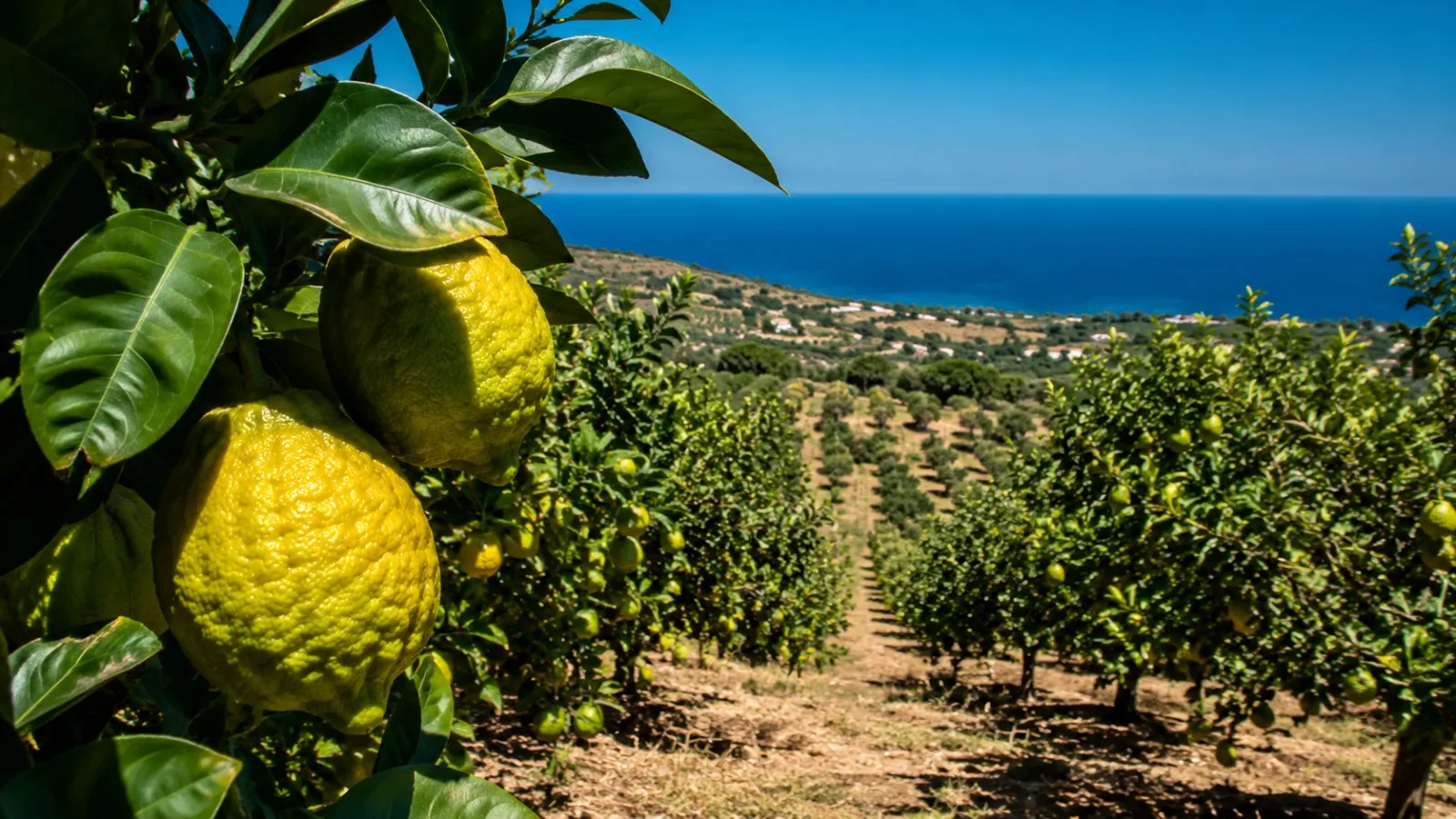
Calabria is the region that forms the tip of the Italian boot, and along its Ionian coast — a strip of land around Reggio Calabria — grows almost all of the world’s bergamot. If you have ever admired the bright, bitter, faintly floral lift at the top of a cologne, or the crisp opening of a fresh modern scent, you have very likely smelled Calabria without knowing it.
This guide is part of the LuxeSkinDaily fragrance atlas — a growing set of origin guides that look at where perfume materials come from and why place matters.
Why bergamot settled in Calabria
Bergamot is a strange citrus. The tree, Citrus bergamia, produces a fruit that looks like a small, slightly pear-shaped orange with a yellow-green skin — and almost nobody eats it. Its flesh is sour and bitter. Its value lies entirely in the peel, which holds an essential oil of unusual finesse.
What makes Calabria remarkable is how narrowly the tree thrives there. Bergamot is famously particular about where it will grow well, and the coastal strip of Reggio Calabria — with its mild winters, sea air, and specific soils — has proved to be its natural home. Growers elsewhere have planted bergamot, but the Calabrian coast remains the reference for quality, and the region’s oil carries a protected designation of origin within the European Union.
That concentration of one material in one small place gives Calabria something in common with Grasse: a local economy, a body of craft knowledge, and a landscape all organised around scent.
The character of bergamot
Bergamot sits in an unusual position among perfume materials. It is a citrus, but it does not smell quite like any other citrus.
Lemon is sharp and sunny; sweet orange is juicy and simple. Bergamot is more complex — bright at first, then bitter, green, and gently floral underneath, with a smoothness that makes it feel polished rather than merely zesty. Perfumers prize it because it lifts a composition without cheapening it: it can open a formal chypre, freshen a floral, or carry an entire cologne almost on its own.
That balancing act is why bergamot became the cornerstone of the eau de cologne tradition, and why it still opens a remarkable share of fine fragrances today. It is also the note that flavours Earl Grey tea — for many people, the most familiar meeting with Calabria they have ever had.
How the harvest shapes the scent
Bergamot is a winter crop. The fruit is picked in the cold months, roughly from late autumn into early spring, when the oil in the peel is at its best.
The oil itself is not distilled but cold-pressed from the rind, a method that preserves the fresh, lively character heat would dull. It takes a large quantity of fruit to yield a modest amount of essence, which is part of why genuine Calabrian bergamot is treated as a precious material rather than a commodity.
Handling matters, too. Citrus oils are volatile and fade quickly once exposed to air and light, so freshness is not a marketing word here — it is a technical requirement. The quality of a bergamot note in the bottle traces directly back to how recently, and how carefully, the peel gave up its oil.
A working landscape, not a postcard
It is tempting to imagine fragrance origins as picturesque backdrops, but Calabria’s bergamot groves are a working agricultural landscape with generations of accumulated skill behind them. The knowledge of when to pick, how to press, and how to judge an oil is local and practical, passed down through families and consortia that have organised around the fruit.
The European protected designation for Bergamotto di Reggio Calabria exists precisely because that provenance is worth defending. When a perfume house specifies Calabrian bergamot, it is naming a place and a standard, not adding a flourish. For anyone learning to read fragrance more closely, that is the useful lesson: freshness of this quality is grown and pressed, not invented in a lab alone.
If Calabria is your kind of scent
In the LuxeSkinDaily Fragrance Finder, Calabria is the origin matched to the Fresh Minimalist profile — a leaning toward clean, understated, quietly polished scents built on citrus and light woods. If that sounds like you, a few next steps are worth taking.
Fresh fragrances live and die by their openings, so learn to give them a fair hearing with our guide on how to sample luxury fragrance. Because citrus notes are among the most fragile in perfumery, how to store perfume correctly matters more for this profile than almost any other. And if you are placing a fresh scent alongside richer ones, how to build a fragrance wardrobe will help you give each its role.
Not sure a fresh citrus is your direction? Take the Fragrance Finder to see which of the six profiles fits you, or open the Fragrance Atlas to explore the other origins — from the flower fields of Grasse to vanilla in Madagascar, covered in our vanilla fragrance guide.
Calabria proves a quiet point: sometimes an entire family of perfumery rests on one fruit, from one coast.