
In this guide5 sections
Before a fragrance is a bottle on a shelf, it is a place. For the deep, resinous, smoke-touched side of perfumery, that place is a peninsula where scent is not an accessory but a language.
The Arabian Peninsula holds a different kind of origin story from the others in this atlas. Grasse grows flowers; Calabria grows bergamot. Arabia’s contribution is above all a culture — centuries of knowing how to burn, blend, layer, and wear fragrance, built around oud, frankincense, amber, and resins. Modern luxury perfumery’s fascination with these materials is, at heart, a long conversation with this region.
This guide is part of the LuxeSkinDaily fragrance atlas — a growing set of origin guides that look at where perfume materials come from and why place matters.
The incense lands
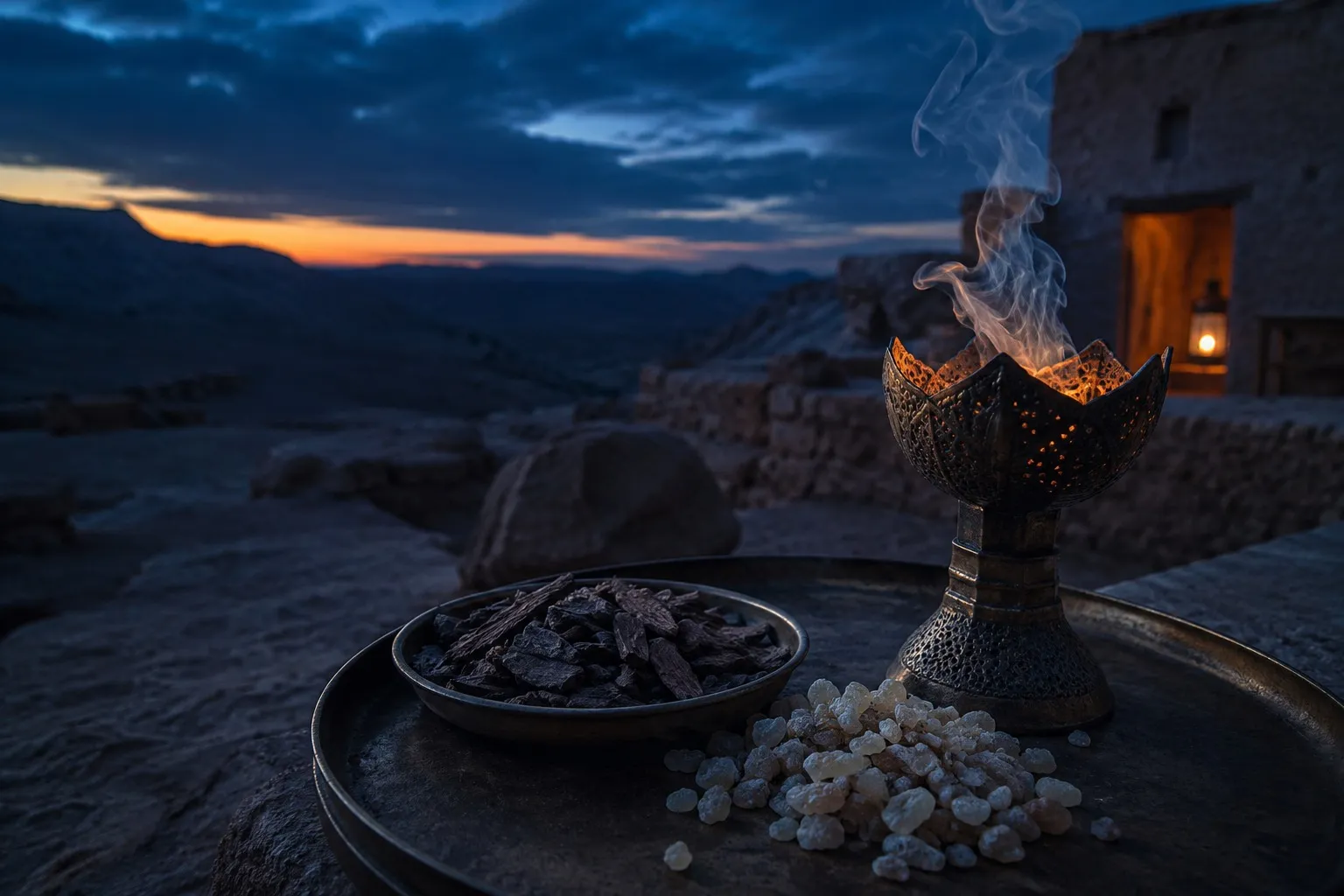
Scent has moved through Arabia for millennia. The southern edge of the peninsula — the Dhofar region of Oman and the lands of Yemen — is home to Boswellia sacra, the tree whose dried resin is frankincense. In antiquity, that resin was among the most valuable substances in trade, carried north along caravan routes that came to be known as the incense roads.
Frankincense is harvested by scoring the tree’s bark and collecting the tears of resin that harden in the air. Burned, it gives the lifting, citrus-edged, church-and-desert smoke the world has prized for thousands of years; in perfume, it lends compositions solemnity and light at the same time. Few materials carry so much history in so small a tear.
Oud: the wounded wood
If frankincense is Arabia’s ancient export, oud is its modern signature — with a twist of geography worth being honest about. The material comes from Aquilaria trees, which do not grow on the peninsula at all but in the forests of South and Southeast Asia. When the tree is wounded or infected, it defends itself by saturating the affected heartwood with dark, fragrant resin. That transformed wood is agarwood — oud.
What makes oud an Arabian story is what the region did with it. Gulf perfumery adopted oud as its centrepiece centuries ago: burned as chips to scent homes and clothing, distilled into dehn al oud — the pure oil worn directly on skin — and prized as a marker of hospitality and occasion. The Peninsula became the material’s great connoisseur culture, the place where its grades, ages, and origins are debated the way vintages are elsewhere.
Oud itself is intense: animalic, woody, sweetly rotten and noble at once. Rare and costly in its natural form, it appears in most Western perfumery through blends and synthetic interpretations — but the benchmark of what “real oud” means still lives in the Gulf.
Layering: fragrance as ritual
The Peninsula’s deepest lesson for any fragrance lover is not a material but a method.
Traditional Gulf scent culture layers. Bakhoor — wood chips soaked in fragrant oils — is burned so its smoke perfumes clothes, hair, and rooms. Oils and attars go directly on skin. A sprayed fragrance may be added over both. The result is not one scent but a composed atmosphere, personal and dimensional, built in stages the way an outfit is.
That approach explains the character of Middle Eastern-inspired perfumery: generous, long-lasting, unafraid of depth. Where some traditions treat fragrance as a discreet finishing touch, this one treats it as presence — something meant to be noticed, remembered, and renewed through the day.
A living tradition, not a trend
Western perfumery periodically “discovers” oud, and shelves fill with dark bottles and Arabic-inflected names. It is worth remembering that behind the trend sits an unbroken, living tradition: households that have burned bakhoor for generations, perfumers in the Gulf blending attars as their predecessors did, and a regard for scent as an expression of respect — for guests, for occasions, for oneself.
For the fragrance buyer, that context is practical. Amber, oud, and incense compositions reward commitment: they wear close and long, they suit evenings and cooler air, and they carry more presence than fresher families. Understanding where that style comes from makes it easier to wear it well — knowingly, rather than loudly.
If Arabia is your kind of scent
In the LuxeSkinDaily Fragrance Finder, the Arabian Peninsula is the origin matched to the Amber Explorer profile — a leaning toward deep, resinous, adventurous scents. If that sounds like you, a few next steps are worth taking.
Rich ambers and ouds evolve for hours, so never judge one on the first ten minutes — our guide on how to sample luxury fragrance shows how to give them a fair trial. Scents this assertive also need placing thoughtfully within a collection; see how to build a fragrance wardrobe. And resinous materials age interestingly but still deserve care — how to store perfume correctly covers it.
Not sure the deep end is your direction? Take the Fragrance Finder to see which of the six profiles fits you, or open the Fragrance Atlas to explore the other origins — from sandalwood in Mysore to vanilla in Madagascar, covered in our vanilla fragrance guide.
Arabia’s lesson is the oldest one in perfumery: fragrance was a ritual long before it was a product.