
In this guide5 sections
Before a fragrance is a bottle on a shelf, it is a place. For the warm, enveloping sweetness at the heart of gourmand perfumery, that place is a large island off the southeastern coast of Africa.
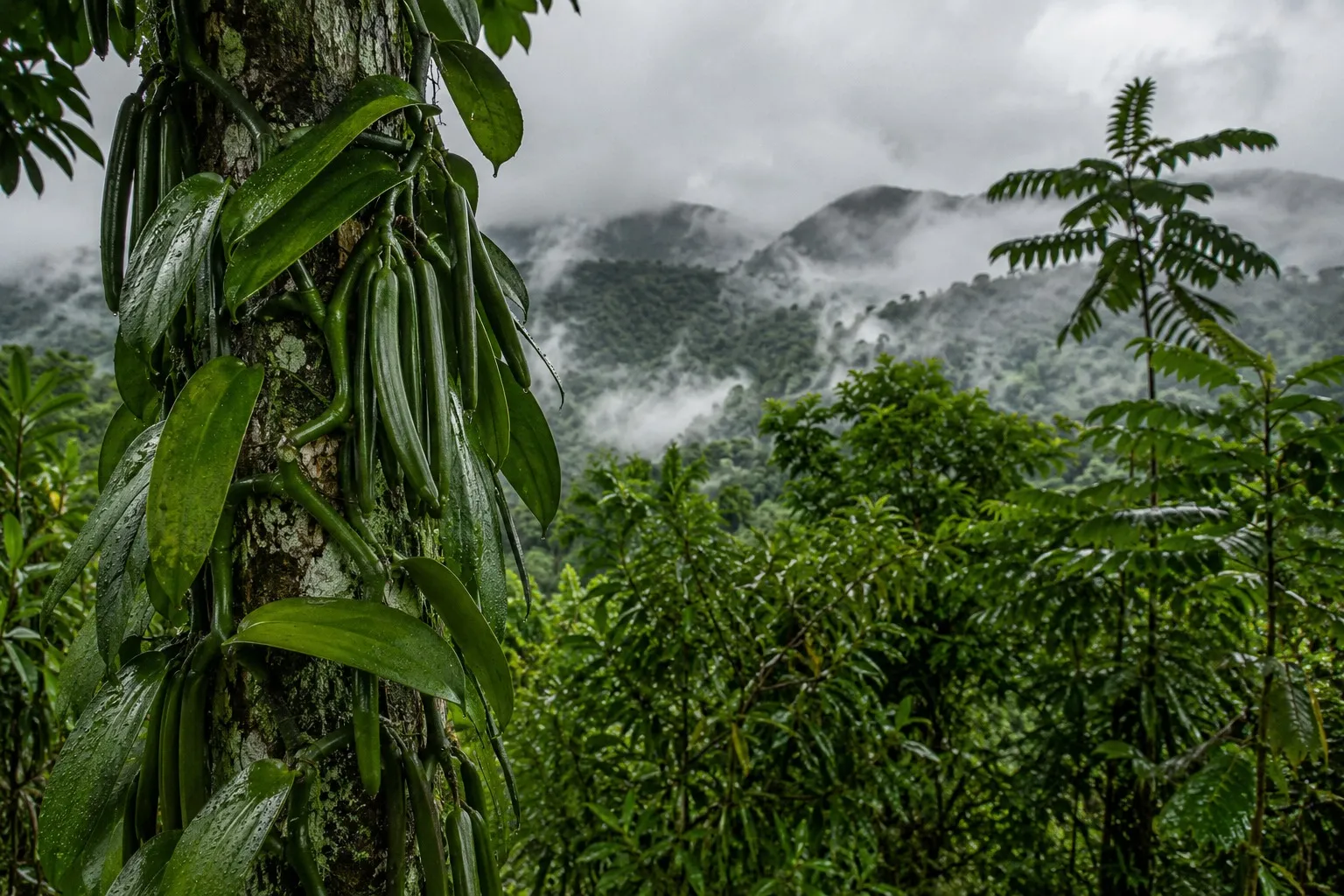
Madagascar is the origin most closely associated with vanilla — the material that anchors an entire family of modern fragrance. The island’s northeast, humid and green, grows the orchids whose cured pods carry that deep, creamy, faintly smoky sweetness perfumers reach for when they want a scent to feel like comfort. If you love fragrances that wear like warmth itself, this is where much of that warmth begins.
This guide is part of the LuxeSkinDaily fragrance atlas — a growing set of origin guides that look at where perfume materials come from and why place matters.
An orchid far from home
Vanilla is not native to Madagascar. The plant, Vanilla planifolia, is an orchid from Mexico, where a local bee pollinates its flowers. When growers carried the vine across the world to the islands of the Indian Ocean in the nineteenth century, it flowered readily — and set no pods, because its pollinator had stayed behind.
The solution was found on the neighbouring island of Réunion, then called Île Bourbon: a practical technique for pollinating each flower by hand, credited to Edmond Albius, a young enslaved man on the island, in 1841. That discovery made vanilla cultivation possible across the region, and it is why vanilla from Madagascar and its neighbours is still called Bourbon vanilla — a reference to the island, not the whiskey.
Madagascar’s northeast proved exceptionally suited to the vine, and the island grew into the world’s reference origin for vanilla, much as Grasse became the reference for fine florals.
The most patient crop in perfumery
Real vanilla is often described as one of the most labour-intensive agricultural products in the world, and the description is earned at every step.
Each orchid flower opens for a very short window, and each must be pollinated by hand — one flower, one gesture, no shortcuts. The green pods that follow take months to mature on the vine, and when they are picked they smell of almost nothing.
The scent everyone knows is created by curing. Pods are scalded, then sweated and sun-dried in careful cycles, then rested in the shade for further months while their aroma slowly develops and deepens. From flower to finished pod, the process spans the better part of a year and passes through many pairs of hands. When a fragrance house speaks of natural vanilla as a precious material, this patience is what the word means.
What vanilla does in a fragrance
Vanilla’s reputation for simple sweetness undersells it. A good natural vanilla is a complex material — creamy and sugared, yes, but also woody, balsamic, faintly leathery, with a smoky edge from the curing.
In perfumery it plays several roles at once. As a base note it gives a composition longevity and a soft landing. As a character it turns a scent plush and intimate. And as the anchor of the gourmand family — fragrances built around edible warmth — it does for comfort what bergamot does for freshness. Alongside it, Madagascar also grows ylang-ylang, the intensely floral blossom that often rounds out these warm compositions.
The difference between a flat, sugary vanilla and a deep, layered one usually comes down to material quality — which is to say, it comes down to origin and craft.
A livelihood, not just a note
For the growing regions of northeastern Madagascar, vanilla is not an ingredient story but a mainstay of local livelihoods, cultivated on small family plots and traded through the seasons. The material’s value reflects genuine scarcity: a crop this dependent on hand labour and long curing cannot be rushed or mass-produced without becoming something else.
That is worth keeping in mind as a fragrance buyer. Synthetic vanillin has its place and appears in countless good perfumes, but when a composition specifies natural vanilla from Madagascar, it is pointing at a real place, a real crop, and a year of real work.
If Madagascar is your kind of scent
In the LuxeSkinDaily Fragrance Finder, Madagascar is the origin matched to the Warm Gourmand profile — a leaning toward enveloping, softly sweet, comforting scents. If that sounds like you, the next step is easy, because this is the one origin whose fragrances we have already covered in depth: our guide to the best vanilla fragrances walks through six considered choices, from airy to opulent.
Beyond that, warm scents reward patience on skin, so read how to sample luxury fragrance before judging one on a quick spray. And how to build a fragrance wardrobe will help a rich gourmand share shelf space with lighter signatures.
Not sure a gourmand is your direction? Take the Fragrance Finder to see which of the six profiles fits you, or open the Fragrance Atlas to explore the other origins — from the flower fields of Grasse to sandalwood in Mysore.
Vanilla asks for a year of patience before it ever reaches a bottle. The least a wearer can give it is a slow afternoon.